First Prize of the 2021 Freedom Lab Essay and Creative Writing Competition – Non-fictional Writing.
To view the complete work, please feel free to contact me directly!
The Wok
May, 2021 (excerpt)
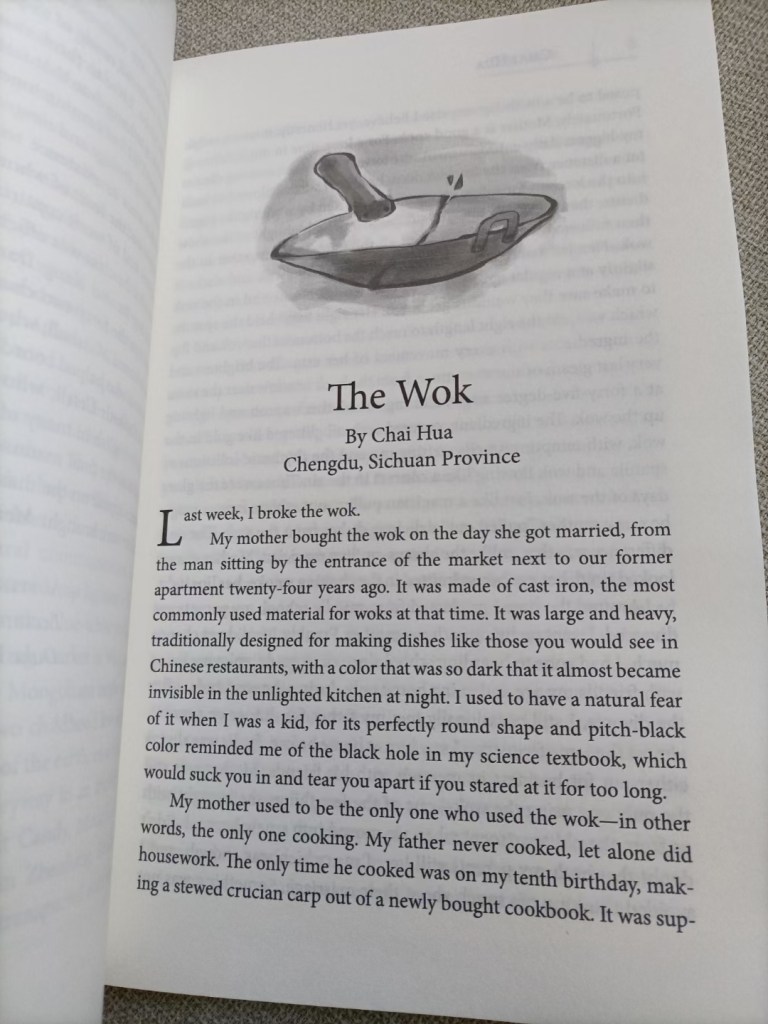
Last week, I broke the wok.
My mother bought the wok on the day she got married, from the man sitting by the entrance of the market next to our former apartment twenty-four years ago. It was made of cast iron, the most commonly used material for woks at that time. It was large and heavy, traditionally designed for making dishes like those you would see in Chinese restaurants, with a color that was so dark that it almost became invisible in the unlighted kitchen at night. I used to have a natural fear of it when I was a kid, for its perfectly round shape and pitch-black color reminded me of the black hole in my science textbook, which would suck you in and tear you apart if you stared at it for too long.
My mother used to be the only one who used the wok—in other words, the only one cooking. My father never cooked, let alone did housework. The only time he cooked was on my tenth birthday, making a stewed crucian carp out of a newly bought cookbook. It was supposed to be a birthday surprise I believe, yet honestly, it tasted awful. Fortunately, Mother is a good cook. For a long time in my childhood, my biggest daily entertainment was to watch Mother cooking dinner (at a distance from the kitchen door, because I wasn’t allowed to walk into the kitchen for safety reasons). She started by washing the ingredients, then cut them into the proper size. The highlight of the show then followed, when Mother fried all the ingredients together in the wok. Her left hand would hold the handle of the wok and shake it slightly at a regular speed, moving the ingredients around in the wok to make sure they wouldn’t get burnt. Her right hand held the spatula, which was just the right length to reach the bottom of the wok and flip the ingredients with every movement of her arm. The brightest and very last gleam of sunset came in from the back window near the stove at a forty-five-degree angle, shining on Mother’s apron and lighting up the wok. The ingredients covered with oil glittered like gold in the wok, with tempting smells wafting out and the rhythmic collisions of spatula and wok flowing like a concert in the air. Those were the glory days of the wok. Just like a magician pulling out rabbits from a magic box, my mother “pulled out” delicious dishes from the wok. The only difference was that unlike the always-smiling magician, Mother always looked tired, her eye brows knitted in the choking smoke, her lips tight.
Around the time I graduated from middle school, my parents got divorced. I went on living with my mother. Frankly, life did not change much. I had gone to boarding school since sixth grade, enjoying living with friends my age and going home only during the weekends. After the divorce, I still occasionally met my father for dinner or a movie, almost the same frequency I saw him at home before, for he was always either out for business or meeting with his friends. Mother was still the only one using the wok—one of the few things she brought with us from the old apartment when we moved into a new home. I didn’t doubt that both my parents still loved me, which was enough, and I avoided thinking too much about their marriage. Something was not right, yet I couldn’t tell or maybe didn’t want to uncover what exactly wasn’t right.
A visit to a friend’s house somehow revealed part of the answer. I was truly surprised to know that her father was the one cooking in the family and doing most of the housework. That might be the exact point where something quietly changed in my feelings towards the wok. It was no longer a magical box for me, but rather a chain. My passion and romantic vision for cooking vanished. I would recklessly argue back at family gatherings when an elder relative would unconsciously express ideas such as that girls should learn cooking,
“I don’t know how to cook, but I can find a boyfriend who cooks. Who says that the girl should be the one cooking? I can also order takeaway. I don’t need to, and I don’t want to learn cooking.” Mother always kept silent at such moments. Only once, when there were just two of us watching television at night, she said softly to me during the commercial break, “Not for anyone else, but for taking care of yourself, you should learn how to cook. I can’t cook for you forever.” The end of her sentence faded into the sound of the television, almost like it had never existed. I probably caught her words, or it was just an illusion. The TV show started up again. I quickly forgot about it.
As I neared the end of high school, the pressures of the gaokao became more and more immediate…
 Exploration of Media and Humanity